Food Tech · Product Management · User Research
FoodMindful
From Grocery Receipts to Zero Waste
Role
Product Manager
Team
6-person cross-functional squad
Context
NC State InnoLab x Raleigh Founded
Outcome
People's Choice Award, Demo Day
Recognition
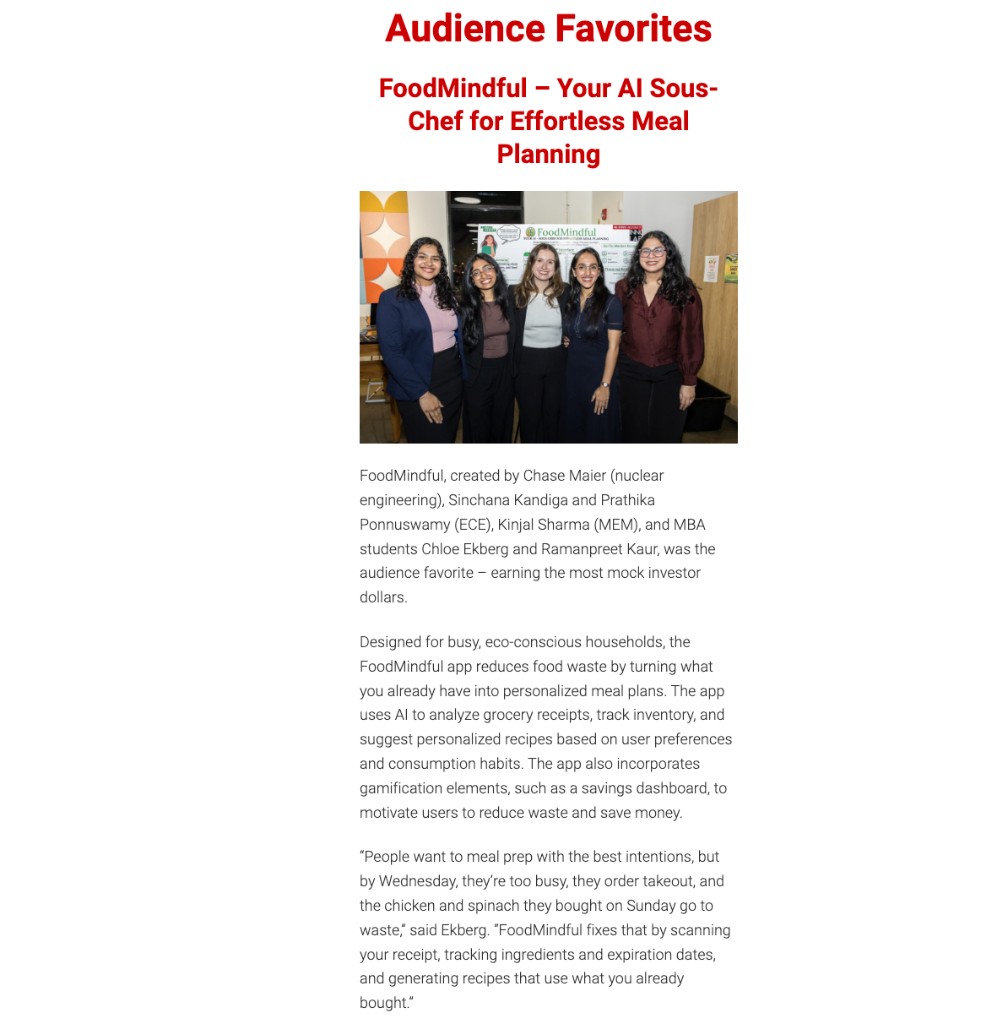
Audience Favorites: earning the most mock investor dollars
NC State InnoLab Demo Day in partnership with Raleigh Founded It, competing against all teams in the cohort.
The Problem
Why food waste keeps happening even when people try
Existing tools like Mealime, PlateJoy, and MyFitnessPal address meal planning, but none of them solve why people actually waste food. They add more to manage, not less.
$728
wasted per person annually on uneaten food
10 hrs
spent managing meals and groceries every week
77%
say choosing what to cook is the hardest part
Research
We did not start with assumptions. We went outside.
I led end-to-end product discovery across three research tracks.
17+
User Interviews
Outside Whole Foods & Harris Teeter, Raleigh NC
70+
Survey Responses
Working professionals, couples, students, parents
3+
Expert Consultations
Food policy, waste research, agricultural economics
What the surveys told us
“A major driver of food waste in the US is overbuying during infrequent grocery trips. It is a behavioral pattern, not an awareness gap.”Food waste researcher, NC State
The Insight
It was not an awareness problem. It was decision fatigue.
Going into research, we assumed the problem was awareness. The data told us something different. Busy working professionals were ordering takeout daily not because they wanted to spend money, but because choosing what to cook after a long day felt harder than just ordering out.
Our assumption
People waste food because they lack awareness.
What we found
People waste food because they lack decisions.
This reframed the entire product. We were not building a meal planning app. We were building a decision elimination tool.
Primary ICP
Working professionals without kids
Ages 25-40, urban, time-constrained, tech-savvy, high decision fatigue around meals.
Secondary ICP
Young urban couples
Dual income, city-living, shared meal decision fatigue.
Concept Selection
Five concepts evaluated. One clear winner.
Scored against user effort, feasibility, time-to-value, and adoption likelihood.
Receipt Scanning + AI won decisively. Eliminate manual entry entirely and you remove the single biggest barrier to consistent app use.
The Product
Scan. Plan. Cook. Save.
Four steps designed so the right decision is always the effortless one.
01
Scan
Photograph your grocery receipt. Google Vision OCR extracts items, prices, and quantities instantly. No typing, no setup.
02
Plan
USDA FoodKeeper assigns expiry dates to 650+ food items. ChatGPT-4 + Spoonacular surface recipes that use what is closest to expiring first.
03
Cook
Filtered by dietary preferences, cook time, and what is in your fridge. Tap cooked and inventory updates automatically.
04
Save
A dashboard tracks real dollar savings in plain language: $22 saved this week. Streaks and challenges build the habit.
Technology Stack
Built to eliminate friction at every layer
Competitive Positioning
The only product that checks every box
We mapped FoodMindful against five competitors across four dimensions. FoodMindful was the only product that fulfilled all four.
| Product | Low Manual Entry | Gamified | Adaptive AI | Waste Focus |
|---|---|---|---|---|
| FoodMindful | ✓ | ✓ | ✓ | ✓ |
| MyFitnessPal | - | - | - | - |
| Mealime | - | - | ✓ | - |
| NoWaste | - | - | - | ✓ |
| eMeals | - | - | ✓ | - |
Business Model
Freemium with behavioral upgrade triggers
Free
$0
Limited meal plans, in-app ads
Premium
$4.99/mo
Unlimited plans, no ads, full analytics + 1 month free for referrals
Revenue Projections
Break-even projected at Year 4 with $203K net profit.
Go-To-Market
Four phases from zero to retained
01
Acquire
Micro-influencers (50K-100K followers), paid social targeting SF, Raleigh, Austin, and major US metros, plus App Store optimization.
02
Activate
First meal plan in under 5 minutes. Expiring-item alerts on Day 3. Auto-inventory sync after every receipt scan. Weekly savings summaries.
03
Convert
30-day full-feature trial. Upgrade prompt at scan limit. Social proof showing $875-$1,165 in projected annual savings.
04
Retain
Adaptive AI that learns preferences. Shared couple accounts. Seasonal recipe packs. Streaks and achievements.
What I Owned
End-to-end ownership across research, strategy, and delivery
- +Led all user research across 17+ interviews, 70+ survey responses, and 3 expert consultations
- +Identified decision fatigue as the root cause of food waste, reframing the entire product direction
- +Defined primary ICP through behavioral analysis, not just demographic segmentation
- +Drove concept selection, evaluating five approaches against structured criteria
- +Authored technical PRDs covering receipt scanning logic, inventory tracking, AI recommendation engine, and gamification mechanics
- +Translated 40+ user pain points into specific product features with clear design criteria
- +Managed a six-person Agile squad through weekly sprints and backlog grooming
- +Prototyped the full frontend using AI-assisted development tools
- +Presented at NC State InnoLab Demo Day in partnership with Raleigh Founded It
Key Learnings
The most important lesson was not technical.
The best product insight came not from survey data but from standing outside a grocery store and asking people why they throw food away. The answer was never “I don't care.” It was always some version of “I ran out of time” or “I could not decide.”
“A product that removes the decision entirely, rather than asking the user to make better decisions, is fundamentally different from everything else in the market. That is the insight that won.”
Want to talk product?